Lack of Risk Assessments and Documentation

Most industrial facilities understand the importance of electrical safety.
Most understand the importance of machine safety.
Yet many organisations overlook one of the biggest compliance risks of all:
Poor documentation and inadequate risk assessments.
When an incident occurs, one of the first questions investigators, insurers or regulatory bodies may ask is:
"Can you demonstrate that risks were identified, assessed and controlled?"
If the answer is unclear, or the documentation is missing, the organisation may face significant compliance, legal and operational consequences.
At Stratos Control Systems, we frequently encounter facilities with ageing automation systems where risk assessments have not been updated, documentation no longer reflects reality, or years of modifications have occurred without proper records.
These issues often remain hidden until an audit, system failure or safety incident exposes them.
Why Risk Assessments and Documentation Matter
Risk assessments and technical documentation provide the foundation for safe operation and maintenance.
They help organisations:
-
Identify hazards
-
Reduce operational risks
-
Demonstrate compliance
-
Support safe maintenance practices
-
Protect employees and contractors
-
Facilitate future upgrades
What Happens When Documentation Is Missing?
Many industrial automation systems evolve over years or even decades.
-
Equipment is upgraded.
-
Control panels are modified.
-
Safety circuits are altered.
-
Unfortunately, documentation is often left behind.
Common examples include:
-
Outdated electrical drawings
-
Missing PLC backups
-
Undocumented software changes
-
Incomplete panel schedules
-
Missing cable identification
-
Unrecorded safety modifications
-
Outdated operating procedures
Over time, these gaps create increasing compliance and safety risks.
Why Inadequate Risk Assessments Create Serious Problems
Risk assessments should evolve as systems change.
However, many organisations rely on assessments that:
-
Were completed years ago
-
Do not reflect current equipment
-
Ignore software modifications
-
Exclude automation systems
-
Have never been reviewed following upgrades
As a result, hazards may exist without being properly evaluated or controlled.
Warning Signs Your Site May Have Documentation and Risk Assessment Gaps
Electrical Drawings Do Not Match Reality
Maintenance teams often discover wiring, components or panel changes that do not appear on drawings.
Nobody Knows Which PLC Software Version Is Live
Version control issues can create significant operational and safety risks.
Modifications Are Poorly Documented
Changes completed by contractors or internal teams may never have been formally recorded.
Safety Systems Have Been Altered
Emergency stops, safety relays and interlocks should always trigger a review of risk assessments.
Audits Generate Repeated Findings
Recurring documentation issues often indicate wider compliance weaknesses.
The Real Risks of Poor Documentation
Increased Safety Risk
Maintenance engineers may unknowingly work on systems they do not fully understand.
Delayed Emergency Response
Fault finding becomes slower when documentation is missing or inaccurate.
Compliance Failures
Regulators and auditors often expect evidence that systems have been properly assessed and maintained.
Increased Downtime
Poor documentation makes troubleshooting significantly more difficult.
Higher Upgrade Costs
Future automation projects may require expensive reverse engineering to compensate for missing records.
Insurance and Legal Exposure
Following incidents, documentation often becomes a critical piece of evidence.
Download the Industrial Automation Compliance Audit Checklist
Missing documentation and outdated risk assessments can remain hidden until an audit, incident or system failure exposes them.
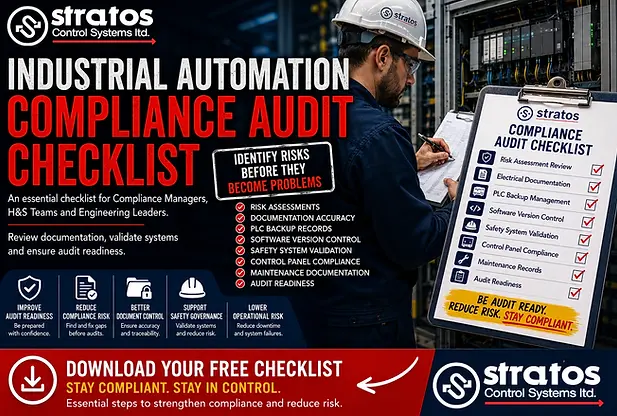
Our Industrial Automation Compliance
Audit Checklist helps teams review:
-
Risk assessment gaps
-
Electrical documentation accuracy
-
PLC backup records
-
Software version control
-
Safety system validation
-
Control panel compliance
-
Maintenance documentation
-
Audit readiness
Who This Guide Helps
This guide is particularly relevant for teams responsible for safety, compliance, engineering reliability and site
maintenance.
Health & Safety Managers
For teams responsible for employee safety, incident prevention and demonstrating that risks have been properly assessed and controlled.
Compliance Managers
For compliance teams responsible for audit readiness, documentation evidence, regulatory requirements and internal compliance standards.
Facilities Managers
For facilities managers responsible for safe, compliant and maintainable site infrastructure across buildings, utilities and automation systems.
Engineering Managers
For engineering managers/teams responsible for automation reliability, system maintainability, technical documentation and upgrade planning.
Maintenance Managers
For maintenance managers/teams responsible for safe fault finding, maintenance procedures, accurate drawings and reducing downtime during failures.
Common Documentation Missing from Industrial Automation Systems
Electrical Documentation
This may include:
-
Schematics
-
Wiring diagrams
-
Panel layouts
-
Cable schedules
Automation Documentation
This may include:
-
PLC backups
-
Software revision history
-
HMI documentation
-
SCADA architecture
Safety Documentation
This may include:
-
Risk assessments
-
Functional safety assessments
-
Safety validation records
-
Emergency stop verification
Operational Documentation
This may include:
-
Operating procedures
-
Maintenance instructions
-
Isolation procedures
-
Training records
Each document plays a role in demonstrating compliance and supporting safe operation.
How Stratos Control Systems Supports Compliance
Stratos Control Systems helps organisations improve safety and compliance through:
-
Risk assessment reviews
-
Documentation audits
-
Electrical drawing updates
-
PLC software archiving
-
Safety system assessments
-
Control panel compliance reviews
-
Automation system lifecycle support
We help Health & Safety Managers, Compliance Managers and engineering teams gain confidence that automation systems are properly documented, risks are understood and compliance obligations are being met.
Concerned About Documentation or Compliance Gaps?
If you are responsible for health, safety or regulatory compliance, Stratos Control Systems can help identify documentation deficiencies, review automation risk assessments and support safer, more compliant industrial operations.
Our engineers work with site teams to improve visibility, reduce risk and ensure automation systems remain safe, maintainable and audit-ready.
