Industrial Control Panel Manufacturing

Precision-built industrial control panels manufactured for reliable operation, straightforward installation and long-term maintainability.
Stratos Control Systems manufactures industrial control panels for machinery, production lines, process systems and wider automation applications.
Each panel is assembled from approved electrical drawings and project documentation, with careful attention given to component selection, wiring quality, identification, inspection and testing.
Our manufacturing process is supported by practical automation engineering experience, helping ensure that the completed panel works as part of the wider control system rather than as a standalone enclosure.
Control Panel Manufacturing for Industrial Automation
A well-designed control panel still depends on accurate and consistent manufacture.
Components must be installed correctly, wiring must match the electrical schematics and every connection must be clearly identified and verified before the panel reaches site.
Stratos manufactures control panels for applications including:
-
Industrial machinery
-
Production lines
-
Process control systems
-
PLC automation projects
-
Motor-control applications
-
Machine upgrades
-
Obsolete control panel replacement
-
SCADA and HMI systems
-
Variable-speed drive systems
-
Remote I/O panels
-
Safety-related control systems
-
Building and facilities automation
Manufacturing can be provided as part of a complete design, build, programming and commissioning service or based on an approved customer design package.
Our Control Panel Manufacturing Workflow
A structured manufacturing workflow helps maintain consistency between the approved design and the finished panel.
Our process may include:
-
Reviewing the approved drawings and project documentation
-
Confirming the bill of materials
-
Procuring and checking components
-
Preparing the enclosure and mounting plates
-
Installing components and cable-management systems
-
Completing power and control wiring
-
Applying wire, terminal and component identification
-
Inspecting the completed assembly
-
Performing electrical and functional testing
-
Recording approved changes
-
Preparing the panel for delivery or installation
-
Updating documentation where required
The workflow is adapted according to the size, complexity and technical requirements of the project.
Design Review Before Manufacture
Before manufacturing begins, the approved design package is reviewed to identify anything that could affect the panel build.
This review may include:
-
Electrical schematics
-
Panel layouts
-
I/O schedules
-
Terminal plans
-
Cable schedules
-
Component lists
-
Thermal calculations
-
Cable-sizing information
-
Enclosure requirements
-
Customer specifications
-
Applicable engineering standards
-
Installation and environmental conditions
Early review helps identify missing information, component conflicts or layout issues before they create manufacturing delays.

Component Selection
Reliable control panel manufacturing begins with suitable component selection.
Electrical components must be appropriate for the application, operating environment, electrical load and wider control-system architecture.
Components may include:
-
PLC processors
-
Input and output modules
-
Power supplies
-
Circuit breakers and fuses
-
Contactors and relays
-
Motor-protection devices
-
Variable-speed drives
-
Safety relays
-
Safety PLCs
-
Network switches
-
HMIs
-
Isolators
-
Control transformers
-
Terminal blocks
-
Cooling and ventilation equipment
-
Push buttons, lamps and selector switches
Selection may be based on the approved design, customer standards or agreed manufacturer preferences.

Factors Considered During Component Selection
Component selection is not based only on the initial purchase cost.
Our engineers may also consider:
-
Electrical rating
-
Duty and expected load
-
Environmental conditions
-
Product availability
-
Manufacturer support
-
Obsolescence risk
-
Spare-parts availability
-
Compatibility with existing systems
-
Maintenance requirements
-
Communication protocols
-
Future expansion
-
Customer standardisation
-
Physical panel space
-
Heat generation
Choosing suitable, supportable components helps reduce future maintenance difficulties and unexpected replacement problems.
Approved and Traceable Components
Components are checked against the approved bill of materials before installation.
This helps confirm:
-
Correct manufacturer
-
Correct part number
-
Suitable electrical rating
-
Required quantity
-
Compatibility with the design
-
Correct accessories
-
Required certification or documentation
Where a specified component is unavailable, alternatives should be reviewed and approved before being introduced into the build.
Enclosure Preparation
The enclosure forms the physical foundation of the control panel.
Before components are installed, the enclosure and mounting surfaces are prepared according to the approved layout.
Preparation may include:
-
Marking component positions
-
Cutting door and gland-plate openings
-
Installing mounting plates
-
Installing DIN rail
-
Fitting cable trunking
-
Preparing ventilation openings
-
Installing fans or cooling equipment
-
Fitting gland plates
-
Installing earth studs
-
Preparing door-mounted equipment
-
Checking enclosure dimensions
-
Confirming ingress-protection requirements
Accurate enclosure preparation reduces the risk of component misalignment and unnecessary changes later in the build.

Control Panel Assembly
Electrical components produce heat while operating.
If this heat cannot escape from the enclosure, the internal temperature may rise beyond the recommended operating limits of the installed equipment.
Thermal calculations help determine whether the proposed control panel can manage the expected heat load under normal operating conditions.
The calculation may consider:
-
Heat generated by electrical components
-
Enclosure dimensions
-
Enclosure material
-
Ambient temperature
-
Panel location
-
Internal component density
-
Variable-speed drives
-
Power supplies and transformers
-
Natural heat dissipation
-
Ventilation
-
Filters and fans
-
Air-conditioning or cooling units
-
Required internal temperature
Thermal assessment is particularly important for panels installed in hot production areas, confined plant rooms, outdoor locations or environments with high component densities.

Layout Accuracy During Assembly
The physical panel must reflect the approved design.
During assembly, attention is given to:
-
Component spacing
-
Required clearances
-
Access to terminals
-
Cable-routing space
-
Trunking capacity
-
Heat-producing equipment
-
Power and control segregation
-
PLC and I/O accessibility
-
Door movement
-
Cable-entry points
-
Future spare space
-
Manufacturer installation guidance
Where practical manufacturing issues are identified, they are reviewed before the layout is changed.
Power and Control Segregation
Power circuits, drives and contactors can generate electrical interference and heat.
Sensitive control, communication and instrumentation equipment should therefore be positioned and wired appropriately.
Panel assembly may include segregation between:
-
Incoming power and control circuits
-
Motor wiring and analogue signals
-
Variable-speed drives and PLC equipment
-
Communication cables and power conductors
-
Safety circuits and standard control wiring
-
Mains voltage and extra-low-voltage circuits
-
Heat-producing devices and sensitive electronics
Correct segregation supports reliability and makes the panel easier to inspect and maintain.
Control Panel Wiring
Once the components are installed, the panel is wired according to the approved electrical schematics.
Wiring may include:
-
Incoming power connections
-
Internal power distribution
-
Control-voltage circuits
-
PLC input and output wiring
-
Motor-control circuits
-
Drive wiring
-
Safety circuits
-
Instrumentation wiring
-
Network connections
-
Terminal wiring
-
Door-mounted equipment
-
Earth and bonding connections
Each circuit should correspond with the electrical drawings and associated wire references.

Wire Preparation and Termination
Good termination practices help prevent loose connections, intermittent faults and premature failure.
The wiring process may include:
-
Correct conductor sizing
-
Suitable insulation type
-
Consistent wire preparation
-
Appropriate ferrules and lugs
-
Correct terminal selection
-
Controlled tightening
-
Secure cable routing
-
Bend-radius consideration
-
Cable support
-
Screen and earth termination
-
Separation of signal types
-
Identification at both ends
Terminations are checked during inspection and testing.
Wire, Terminal and Component Identification
Clear identification helps engineers understand and maintain the panel throughout its operational life.
Identification may include:
-
Wire numbers
-
Terminal numbers
-
Component tags
-
Device labels
-
Cable references
-
PLC module references
-
I/O channel references
-
Panel labels
-
Safety labels
-
Voltage-warning labels
-
Equipment descriptions
-
Drawing references
Consistent labelling helps connect the physical panel to the electrical drawings, I/O schedule and PLC program.
Quality Inspection
Quality inspection is carried out during and after assembly to confirm that the panel matches the approved design and workmanship requirements.
Inspection may cover:
-
Component identity
-
Component position
-
Mechanical security
-
Wiring routes
-
Wire identification
-
Terminal identification
-
Conductor size
-
Termination quality
-
Protective devices
-
Earth connections
-
Power and control segregation
-
Cable trunking
-
Door-mounted equipment
-
Warning labels
-
Enclosure condition
-
General workmanship
Identifying issues before testing reduces the risk of faults appearing later in the project.
Drawing-to-Panel Verification
The completed panel should be checked against the approved documentation.
This may include verifying:
-
Component references
-
Wire numbers
-
Terminal numbers
-
PLC addresses
-
Fuse and breaker ratings
-
Cable sizes
-
Power-supply arrangements
-
Motor circuits
-
Safety circuits
-
Network connections
-
Panel layout
-
Door-mounted controls
Any approved manufacturing changes should be recorded so the final drawings can reflect the completed panel.
Control Panel Testing
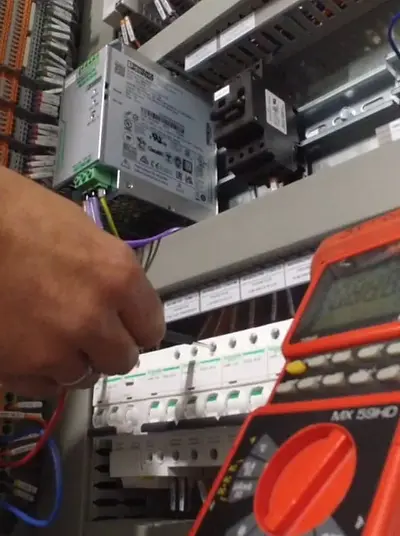
Testing confirms that the panel has been assembled and wired correctly before it is installed on site.
The exact testing scope depends on the project, but may include:
-
Visual inspection
-
Continuity testing
-
Protective-conductor testing
-
Insulation-resistance testing
-
Voltage checks
-
Power-supply checks
-
Polarity checks
-
Terminal verification
-
Input and output testing
-
Control-circuit testing
-
Safety-circuit testing
-
Network checks
-
Device communication checks
-
HMI checks
-
PLC hardware checks
Testing helps identify wiring errors, missing connections and component issues before the panel reaches the installation or commissioning stage.
Dead Testing
Dead testing is completed before the control panel is energised.
It may include:
-
Continuity checks
-
Earth-continuity checks
-
Insulation-resistance testing
-
Circuit verification
-
Terminal checks
-
Short-circuit checks
-
Protective-device checks
-
Polarity verification
This stage helps confirm that the panel is safe to energise and that the basic wiring is correct.
Live Electrical Testing
Once the panel has passed the required preliminary checks, live testing may be completed under controlled conditions.
This may include:
-
Incoming-voltage verification
-
Control-voltage checks
-
Power-supply output checks
-
Phase checks
-
PLC power-up
-
I/O-module checks
-
Network-device checks
-
HMI operation
-
Relay and contactor operation
-
Drive power-up
-
Control-circuit operation
The testing process should be carried out by competent personnel using appropriate safety procedures.
I/O Testing
Input and output testing confirms that the PLC hardware, terminal connections and connected devices correspond with the I/O schedule and electrical drawings.
Testing may include:
-
Digital input simulation
-
Digital output operation
-
Analogue input checks
-
Analogue output checks
-
PLC address verification
-
Channel identification
-
Device-state confirmation
-
Alarm testing
-
Interlock testing
-
Feedback-signal checks
-
Fail-state checks
Changes identified during testing should be reflected in the final documentation.
Functional Testing
Where PLC software and HMI applications are available, the control panel may also undergo functional testing.
Functional testing can verify:
-
Control sequences
-
Start and stop functions
-
Alarm handling
-
Interlocks
-
Safety-related functions
-
Motor-control operation
-
Drive commands
-
HMI controls
-
Status indication
-
Manual and automatic modes
-
Communication between devices
-
Fault responses
Functional testing helps confirm that the electrical panel and control software work together as intended.
Factory Acceptance Testing
For suitable projects, a Factory Acceptance Test can be completed before delivery.
The test allows agreed panel functions and documentation to be reviewed in a controlled environment.
A Factory Acceptance Test may include:
-
Documentation review
-
Visual inspection
-
Electrical test results
-
PLC and HMI demonstration
-
I/O simulation
-
Alarm testing
-
Interlock testing
-
Safety-function checks
-
Communication testing
-
Customer-specific test requirements
-
Recording of comments or actions
Completing agreed checks before delivery can reduce installation risk and commissioning delays.
Quality Documentation
The completed manufacturing package may include:
-
Approved electrical drawings
-
Panel layout drawings
-
I/O schedules
-
Terminal plans
-
Component schedules
-
Test records
-
Inspection records
-
Factory Acceptance Test documents
-
Product documentation
-
Device manuals
-
Approved change records
-
As-built drawings
The required documentation should be agreed at the start of the project.
Manufacturing for New Control Systems
For new automation projects, Stratos can manage the process from initial design through to completed panel manufacture.
This integrated service can include:
-
Control-system architecture
-
Electrical design
-
Component selection
-
Panel layout
-
Thermal calculations
-
Cable sizing
-
I/O schedule development
-
Control panel assembly
-
PLC programming
-
HMI or SCADA development
-
Panel testing
-
Factory Acceptance Testing
-
Installation support
-
Commissioning
-
As-built documentation
Keeping these activities connected helps reduce gaps between the electrical design, software and physical panel.
Replacement and Refurbishment Panels
Stratos can also manufacture replacement or refurbished control panels for existing systems.
This may be required where:
-
Components are obsolete
-
The existing panel is unreliable
-
Documentation is incomplete
-
Wiring has deteriorated
-
The panel has been repeatedly modified
-
Spare parts are difficult to obtain
-
Safety improvements are required
-
Additional equipment must be integrated
-
The existing enclosure has insufficient space
Replacement panels can be designed to retain existing functionality while improving reliability, documentation and maintainability.
Manufacturing from Existing Drawings
Where suitable approved drawings already exist, Stratos may manufacture the panel from the customer’s control panel design package.
Before manufacture, the information may be reviewed for:
-
Completeness
-
Component availability
-
Layout practicality
-
Cable-sizing information
-
Protection-device selection
-
Heat dissipation
-
Terminal requirements
-
I/O consistency
-
Manufacturing clarity
Any uncertainties or design issues should be resolved before the panel enters production.
Designing for Installation and Commissioning
A control panel should arrive on site ready for efficient installation and commissioning.
Manufacturing decisions can support this through:
-
Clear terminal identification
-
Accessible cable entries
-
Logical field connections
-
Suitable gland plates
-
Consistent wire numbering
-
Accurate electrical drawings
-
Defined I/O references
-
Clear power connections
-
Removable transport items where required
-
Secure internal components
-
Suitable lifting and handling provisions
These details can reduce installation time and make commissioning more straightforward.
Designing for Maintenance
The manufacturing quality of a control panel affects how easy it is to maintain throughout its life.
A maintainable panel may include:
-
Clear labels
-
Accessible terminals
-
Logical component arrangement
-
Spare terminals
-
Spare I/O capacity
-
Space for testing
-
Consistent wiring practices
-
Replaceable components
-
Accurate documentation
-
Clear isolation arrangements
-
Accessible PLC and network equipment
A well-manufactured panel helps maintenance teams diagnose faults and complete repairs with less disruption.
Integrated Control Panel and Automation Engineering
Stratos combines control panel manufacturing with wider automation expertise.
Our services include:
-
Control panel design
-
AutoCAD Electrical design
-
PLC programming
-
PLC upgrades and migration
-
Machine control
-
SCADA and HMI systems
-
Automation fault finding
-
Testing and commissioning
This integrated approach helps maintain consistency between the approved drawings, completed panel, PLC software and installed equipment.
Why Choose Stratos Control Systems?
Stratos manufactures industrial control panels with practical attention to electrical quality, automation requirements and long-term support.
Working with Stratos provides:
-
Structured manufacturing workflows
-
Practical component selection
-
Accurate panel assembly
-
Clear wiring and identification
-
Quality inspection
-
Electrical and functional testing
-
EPLAN and AutoCAD Electrical capability
-
PLC and automation expertise
-
Support for new and legacy systems
-
As-built documentation
-
UK-based engineering support
Our control panels are manufactured to support reliable operation, efficient installation and straightforward future maintenance.
Discuss Your Control Panel Manufacturing Requirements
Whether you need a new industrial control panel, a replacement for an obsolete system or manufacturing support for an approved design, Stratos Control Systems can help.
Speak to our engineers about a control panel manufactured around your equipment, operational requirements and long-term support needs.
