How PLCs Control Industrial Machinery
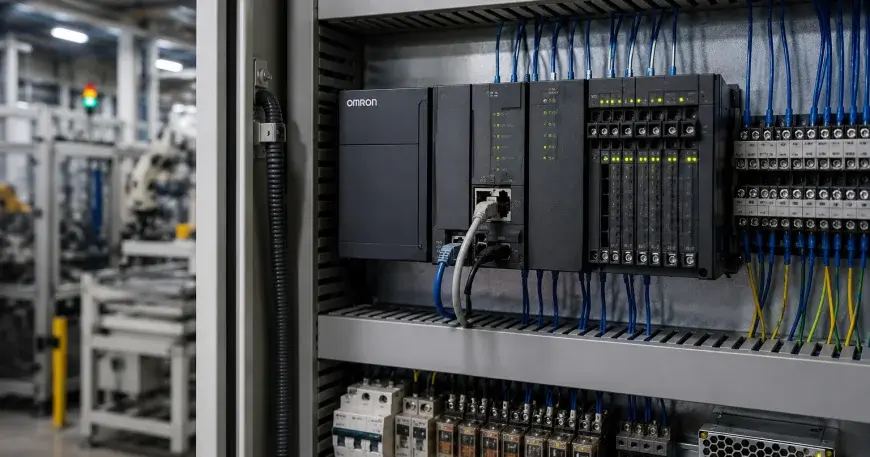
Walk through almost any modern manufacturing or processing facility and there is a good chance that a PLC is controlling at least part of the operation.
Conveyors start and stop automatically. Motors change speed. Valves open at precisely the right point in a process.
Sensors detect products moving along a production line. Filling machines measure quantities, safety systems prevent equipment from operating under unsafe conditions, and alarms warn operators when something has gone wrong.
Behind many of these actions is a Programmable Logic Controller, or PLC.
But how does a PLC actually control industrial machinery?
At its simplest, a PLC continuously receives information from the machinery, processes that information according to its programmed logic and sends instructions back to the equipment. In a real industrial environment, however, that seemingly simple process can involve hundreds or even thousands of signals working together.
What is a PLC?
A PLC is an industrial computer specifically designed to control machinery and automated processes.
Unlike an ordinary computer, PLCs are designed to operate reliably within industrial environments where they may be exposed to electrical noise, vibration, temperature changes and continuous operation.
PLCs are used across manufacturing, food and beverage production, packaging, material handling, pharmaceuticals, utilities and many other industries.
Depending on the application, a PLC might control something relatively simple, such as a conveyor system, or coordinate an entire automated production process involving motors, drives, sensors, pneumatic equipment, robots and other machinery.
The basic PLC control cycle
A useful way to understand PLC control is to think of it as a continuous conversation between the machine and the controller.
The machinery provides information to the PLC through inputs.
The PLC evaluates those inputs using its programmed logic.
It then sends commands through outputs.
This happens repeatedly and extremely quickly.
Imagine a conveyor carrying boxes towards a filling station. A sensor detects when a box reaches the correct position. That signal is sent to the PLC. The PLC determines that the box is present, stops or indexes the conveyor, activates the filling process and waits for confirmation that the required operation has been completed.
Once the correct conditions have been met, the PLC allows the conveyor to continue.
This sequence can repeat hundreds or thousands of times during a production shift without an operator manually controlling each individual action.
Inputs tell the PLC what is happening
For a PLC to control machinery effectively, it needs information about what is happening in the physical process.
This information is provided by input devices.
These can include proximity sensors, photoelectric sensors, pressure switches, temperature sensors, level sensors, limit switches, flow instruments, push buttons and many other field devices.
Inputs can be relatively simple.
For example:
Product detected: Yes or No.
Others provide continuously changing measurements, such as temperature, pressure, speed, level or flow.
The PLC uses this information to understand the current condition of the machine or process before deciding what should happen next.
The PLC program makes the decisions
Receiving information is only part of the process.
The PLC must know what to do with it.
This is determined by the PLC program, which contains the control logic created by an automation or controls engineer.
For example, the program could contain logic that effectively says:
If the machine is enabled, all safety conditions are satisfied, a product is detected and the next station is ready, start the conveyor.
Real industrial control logic can obviously become much more complex.
A production line might require dozens of conditions to be satisfied before a particular operation is allowed to begin. Timers, counters, sequences, calculations, interlocks, alarms and process values may all influence the decision.
The quality of the PLC programming therefore has a significant impact on how reliably and efficiently the machinery operates.
Outputs make things happen
Once the PLC has evaluated the inputs and executed its program, it communicates its decisions through outputs.
Outputs can control equipment such as contactors, solenoid valves, indicator lights, relays, pumps and motor starters.
In more sophisticated systems, the PLC may communicate directly with devices such as variable speed drives (VSDs), servo drives, remote I/O systems, instrumentation and other controllers through an industrial communications network.
This is where the digital decisions being made by the PLC translate into physical actions.
The PLC does not physically move the conveyor itself. Instead, it instructs the equipment responsible for driving the conveyor to operate under the required conditions.
PLCs do more than switch machinery on and off
It is easy to think of PLC control as a series of simple ON and OFF commands, but modern industrial automation is considerably more sophisticated.
A PLC can control the speed of a motor through a variable speed drive, regulate process temperatures, maintain tank levels, coordinate multiple machines, control production sequences and exchange data with other automation systems.
For example, rather than simply starting a pump, the PLC could adjust its operating speed according to pressure or flow measurements received from instrumentation.
The PLC is therefore constantly responding to changing process conditions.
This ability to make decisions based on real-time information is one of the reasons PLCs are so fundamental to industrial automation.
PLCs and machine sequencing
Many industrial machines need operations to happen in a specific order.
Consider a basic automated packaging process.
A product needs to arrive at the correct position before packaging begins. The packaging material needs to be available. Guards must be closed. The machine needs confirmation that the previous cycle has completed successfully.
Only when the required conditions have been satisfied should the next stage begin.
The PLC manages these sequences.
If one of the required conditions is missing, the program can prevent the sequence from continuing and generate an alarm to help the operator understand what has happened.
Good sequence control can therefore improve both production consistency and fault diagnosis.
How PLCs communicate with HMIs
Operators obviously need a way to interact with the automated system.
This is commonly provided through a Human Machine Interface (HMI).
The HMI can display machine status, production information, alarms, process values and operating controls.
An operator might use the HMI to select a product recipe, change an authorised setpoint, acknowledge an alarm or view the status of different areas of the machine.
The PLC remains responsible for the underlying control logic, while the HMI provides a visual interface between the operator and the control system.
In larger installations, PLC data may also be communicated to a SCADA system, giving engineering and operations teams visibility across multiple machines or processes.
PLCs and industrial communication networks
Modern machinery rarely consists of one PLC connected directly to every device.
Industrial communication networks allow PLCs to exchange information with remote I/O, drives, HMIs, SCADA systems, robots and other controllers.
Depending on the equipment involved, technologies such as PROFINET, PROFIBUS, EtherNet/IP, Modbus TCP and other industrial protocols may be used.
This communication allows increasingly complex automation systems to operate as integrated environments rather than isolated pieces of machinery.
It also means that a communication problem can sometimes stop production even when there is nothing mechanically wrong with the machine itself.
What happens when something goes wrong?
PLC-controlled machinery is designed to respond to abnormal conditions.
Suppose a sensor that should detect a product fails to provide the expected signal.
The PLC may prevent the next stage of the sequence from starting and generate an alarm.
Similarly, if a motor drive reports a fault, the PLC can stop the relevant process and prevent dependent equipment from continuing to operate.
This is why PLC diagnostics can be extremely valuable when investigating machinery faults.
An engineer can examine PLC inputs, outputs, alarms, sequence states and communication information to determine what the control system believes is happening.
However, it is important not to assume that every automation fault is a PLC fault.
The PLC may simply be correctly responding to a failed sensor, damaged cable, faulty drive, mechanical problem or another condition elsewhere in the machine.
Effective automation fault finding therefore requires understanding the complete control system, not simply looking at the PLC program.
PLCs also play an important role in machine safety
Safety needs careful distinction from ordinary machine control.
A standard PLC should not automatically be assumed to provide safety-related control functions. Where safety functions are required, appropriately designed safety systems may include safety relays, safety PLCs, safety-rated I/O and other devices selected and engineered according to the applicable requirements.
These systems can monitor conditions such as emergency stops, guard switches and other safety devices.
Safety should therefore be considered as part of the overall machine and control system design rather than simply added to the PLC program afterwards.
Why PLC programming matters
Two machines can contain similar hardware but behave very differently depending on how their control systems have been programmed.
Well-structured PLC software should make the machine predictable, maintainable and easier to diagnose.
Poorly structured software can have the opposite effect.
Over many years, PLC programs can also accumulate modifications as equipment is changed, production requirements evolve and temporary fixes are introduced. Eventually, engineering teams may find themselves maintaining software that nobody fully understands.
This can make even relatively minor faults difficult to diagnose.
Maintaining appropriate PLC documentation, program backups and revision control is therefore an important part of maintaining the machinery itself.
What happens when a PLC becomes obsolete?
Industrial machinery often remains operational far longer than the automation hardware originally installed to control it.
A machine may still be mechanically sound while its PLC platform is approaching or has already reached obsolescence.
This can create a significant operational risk.
Replacement hardware may become difficult to source, software may no longer be supported and the engineers familiar with the original system may no longer be available.
Importantly, PLC obsolescence does not always mean the entire machine needs replacing.
A planned PLC upgrade or migration can often retain much of the existing machinery while replacing ageing control equipment with a supported platform.
Planning this work before a critical PLC fails gives engineering teams considerably more control over the migration process and potential production disruption.
The PLC is only one part of the automation system
PLCs are central to modern industrial automation, but they do not operate alone.
Sensors provide information. PLC software makes decisions. Drives and output devices control physical equipment. HMIs give operators access to the process. Industrial networks connect devices, while control panels provide the electrical infrastructure that brings these systems together.
Understanding these relationships is important when diagnosing faults, upgrading machinery or designing a new automation system.
Rather than looking at the PLC as an isolated component, it is better to consider how the complete automation system interacts with the machinery and production process.
Need support with a PLC-controlled machine?
Stratos Control Systems provides PLC programming, fault finding, control system upgrades and industrial automation support across a range of PLC platforms, including Siemens, Allen-Bradley and Mitsubishi.
Whether you are dealing with an unreliable machine, an obsolete PLC, undocumented software or planning an automation upgrade, understanding the existing control system is the first step towards deciding what needs to change.
Speak to Stratos Control Systems about PLC programming, upgrades, migration and industrial automation support.

