Communication Gaps Between Operations, Engineering and Automation Suppliers

Most automation projects involve multiple stakeholders.
Operations teams focus on production continuity.
Engineering teams focus on reliability and technical performance.
Automation suppliers focus on project delivery and implementation.
When these groups are aligned, projects run smoothly.
When communication breaks down, misunderstandings develop, project risks increase and delivery becomes significantly more difficult.
Many automation projects that exceed budgets or miss deadlines do not fail because of technology. They fail because expectations, requirements and responsibilities were never clearly communicated.
At Stratos Control Systems, we help organisations improve communication between stakeholders to reduce project risk and improve automation project outcomes.
Why Communication Is Critical to Automation Project Success
Automation projects require decisions from multiple departments throughout the project lifecycle.
This includes:
-
Defining project requirements
-
Assessing operational constraints
-
Planning shutdown activities
-
Managing implementation risks
-
Conducting testing and commissioning
-
Supporting long-term operations
Without clear communication, different teams often work towards different expectations.
Why Communication Breaks Down During Automation Projects
Different Priorities Between Departments
Operations teams are often focused on:
-
Maintaining production
-
Meeting output targets
-
Minimising disruption
Engineering teams focus on:
-
Reliability improvements
-
Technical performance
-
Long-term maintainability
Suppliers focus on:
-
Delivering project scope
-
Meeting milestones
-
Managing project risk
Without alignment, priorities can easily conflict.
Assumptions Replace Facts
Many project issues begin with assumptions such as:
-
"Everyone understands the scope."
-
"The supplier knows how the system operates."
-
"Operations understands the shutdown requirements."
When assumptions are not validated, misunderstandings emerge later.
Information Is Shared Inconsistently
Project information is often distributed across:
-
Emails
-
Meetings
-
Drawings
-
Documentation
-
Informal discussions
Important details can easily be missed or interpreted differently.
Stakeholders Become Involved Too Late
Many projects experience issues because:
-
Operations are consulted too late
-
Engineering reviews happen after procurement
-
Suppliers receive incomplete information
Early stakeholder engagement is critical.
The Operational Impact of Communication Gaps
Scope Misunderstandings
Poor communication often leads to:
-
Different interpretations of requirements
-
Missing deliverables
-
Additional engineering work
Project Delays
Projects frequently slow down when teams must revisit:
-
Requirements
-
Responsibilities
-
Technical decisions
This can significantly affect delivery schedules.
Budget Overruns
Miscommunication often creates:
-
Additional engineering hours
-
Scope changes
-
Unexpected implementation work
Increased Commissioning Risk
If stakeholders have different expectations regarding:
-
Testing
-
Acceptance criteria
-
Operational requirements
commissioning becomes significantly more difficult.
Download the Automation Project Communication Checklist
Strong communication is one of the most effective ways to reduce automation project risk.
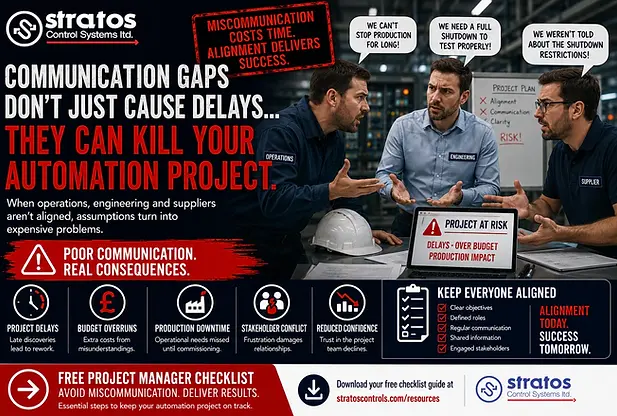
Our Automation Project Communication Checklist helps Project Managers review:
-
Stakeholder responsibilities
-
Project communication plans
-
Scope alignment
-
Change management processes
-
Meeting structures
-
Approval workflows
-
Testing responsibilities
-
Commissioning readiness
Signs Communication Problems Are Already Affecting Your Project
Common warning signs include:
-
Different stakeholders describe the project differently
-
Scope discussions keep reopening
-
Decisions are repeatedly delayed
-
Operations and engineering disagree on priorities
-
Suppliers request frequent clarification
-
Responsibilities are unclear
These indicators often suggest communication risks are increasing.
How Stratos Helps Improve Project Alignment
Stratos Control Systems works closely with operations teams, engineering teams and project stakeholders throughout project delivery.
Our approach focuses on:
-
Clear communication
-
Defined deliverables
-
Structured project management
-
Risk reduction
-
Operational continuity
This helps organisations reduce uncertainty and improve project outcomes.
Improve Communication Before Project Risk Increases
If communication gaps are creating confusion, delays or project risk, now is the time to improve alignment before implementation begins.
Stratos Control Systems helps organisations deliver automation projects with greater clarity, stronger stakeholder engagement and lower delivery risk.
