
Two control panels can meet the same specification and be nothing alike to live with. The difference turns up later: how fast a fault is traced, whether a spare drops straight in, whether the drawings still describe what is actually in the enclosure. Choosing a control panel manufacturer is the decision that sets all three.
What a control panel manufacturer does
Design, build, test. The assemblies are PLC control panels, process control panels, and the panels sitting behind machine control and SCADA and HMI systems. The work runs from the schematic through component selection, enclosure preparation, wiring and identification, to testing before anything leaves the works.
A panel builder assembles from drawings somebody else produced. A control panel manufacturer owns the design too. That distinction stops being academic the first time a drawing is wrong, or a specified part has gone obsolete between quotation and build.
The standards a control panel is built to
Three standards do most of the work on UK control panels.
| Standard | What it governs | What to ask |
|---|---|---|
| BS EN 61439 | Low-voltage switchgear and controlgear assemblies: temperature rise, short-circuit withstand, dielectric properties, degree of protection | Has the design been verified, and to what short-circuit withstand rating in kA |
| BS EN 60204-1 | Electrical equipment of machinery: emergency stop, isolation, protective bonding, wiring methods | Who owns the machinery safety functions, you or them |
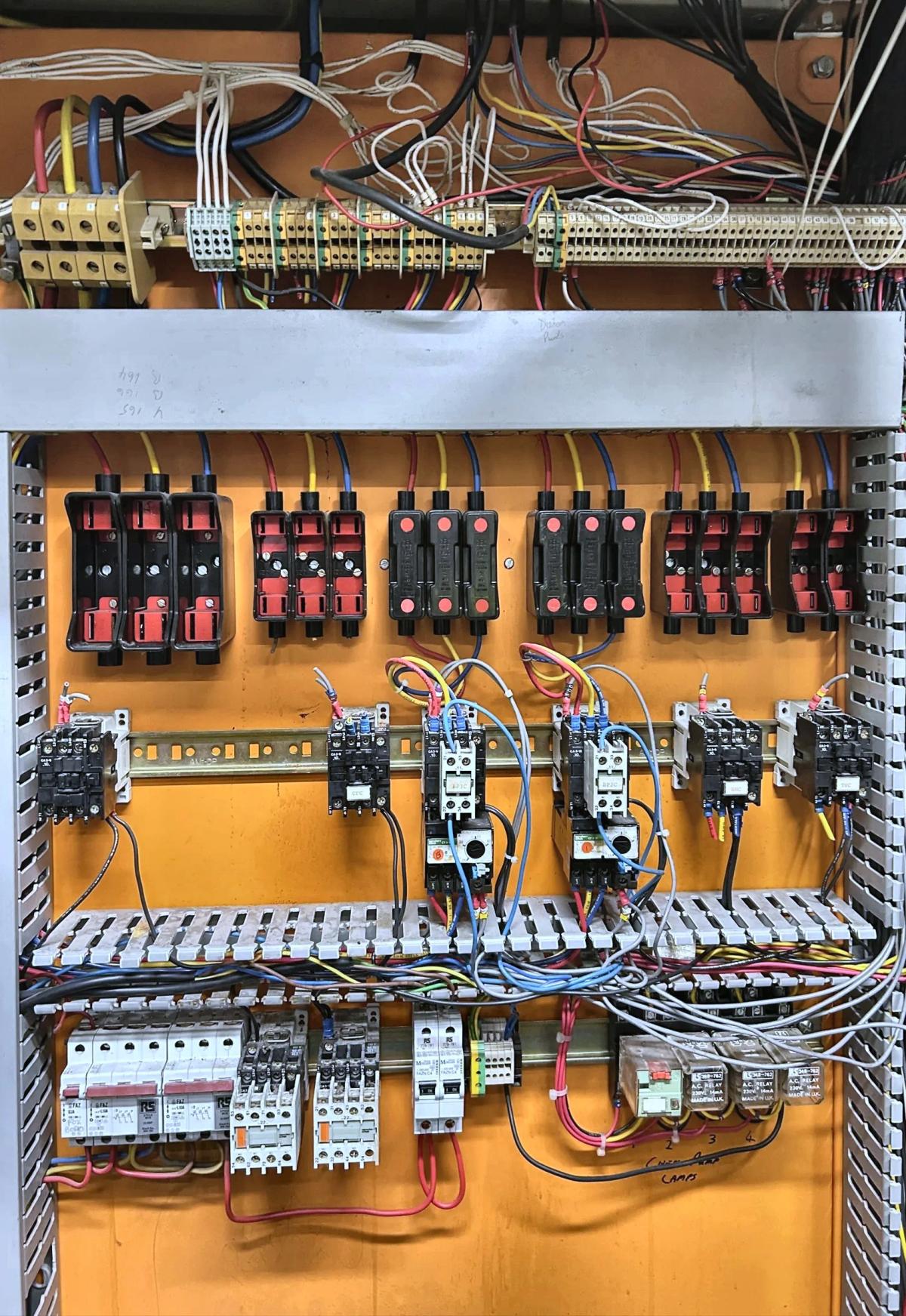
What to check before choosing a control panel manufacturer
Almost everything that separates control panel manufacturers is decided before anyone picks up a crimp tool.
| What to check | Why it matters |
|---|---|
| Experience with the platform you run | Siemens, Allen-Bradley and Mitsubishi behave differently. Someone who has only worked on one will carry assumptions into the others. |
| Design and layout | Component spacing, access to terminals, segregation of power and control, and space left for the additions that always come later. |
| Documentation issued with the panel | Schematics, panel layouts, terminal plans, I/O schedules, test records, and as-built drawings that match what was actually built. |
| Component selection | Obsolescence risk and spares availability beat unit price. A cheaper contactor nobody stocks in three years was not cheaper. |
| Testing before delivery | Dead testing, live testing, I/O testing against the schedule, and a Factory Acceptance Test you are invited to attend. |
| Integration | Whether the same people write the PLC software and commission it, or whether you coordinate two suppliers across one fault. |
| Support afterwards | Who answers the phone, how quickly somebody attends, and whether they still hold your backups. |
New control panel or refurbishment
Not every project needs a new control panel. An enclosure in sound condition, with room to work in, is often worth keeping. The money goes further on what is inside it.
| New build | Refurbishment | |
|---|---|---|
| Best for | New plant, or a panel with no space, degraded wiring or no usable drawings | Sound enclosure, obsolete components, a layout that can be improved |
| Downtime | Built and tested off site, then swapped during a planned shutdown | Usually staged, and it needs more time on site |
| Documentation | Drawn from scratch, so the drawings match the panel | A chance to re-document a system nobody has accurate drawings for |
Control panel documentation is the part people regret
Nobody can safely modify a panel with no drawings. The pack should carry electrical schematics, panel layout drawings, terminal plans, cable schedules, I/O schedules, component schedules, test and inspection records, and as-built drawings updated for every change made during the build. Then ask the question that actually decides whether any of it stays true: who updates the drawings when something changes on site. That is where the record and the panel usually start to drift apart, and it is why we run EPLAN control panel design as its own discipline rather than a step at the end.
Ask a control panel manufacturer what happens in year five
Can they still get the parts. Do they hold a verified backup of the PLC and HMI software, and have they ever restored one. How quickly does somebody attend, and is that a written commitment or a hope.
A manufacturer who also does PLC programming, fault finding and support contracts is answering a different question from one who builds the panel and hands over the keys.