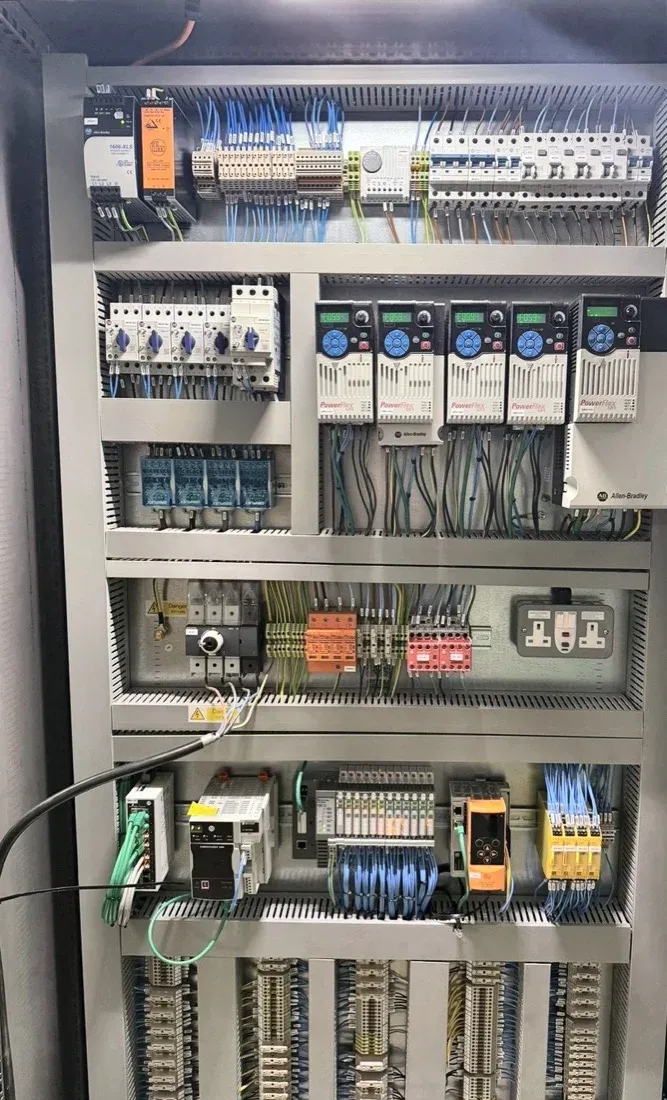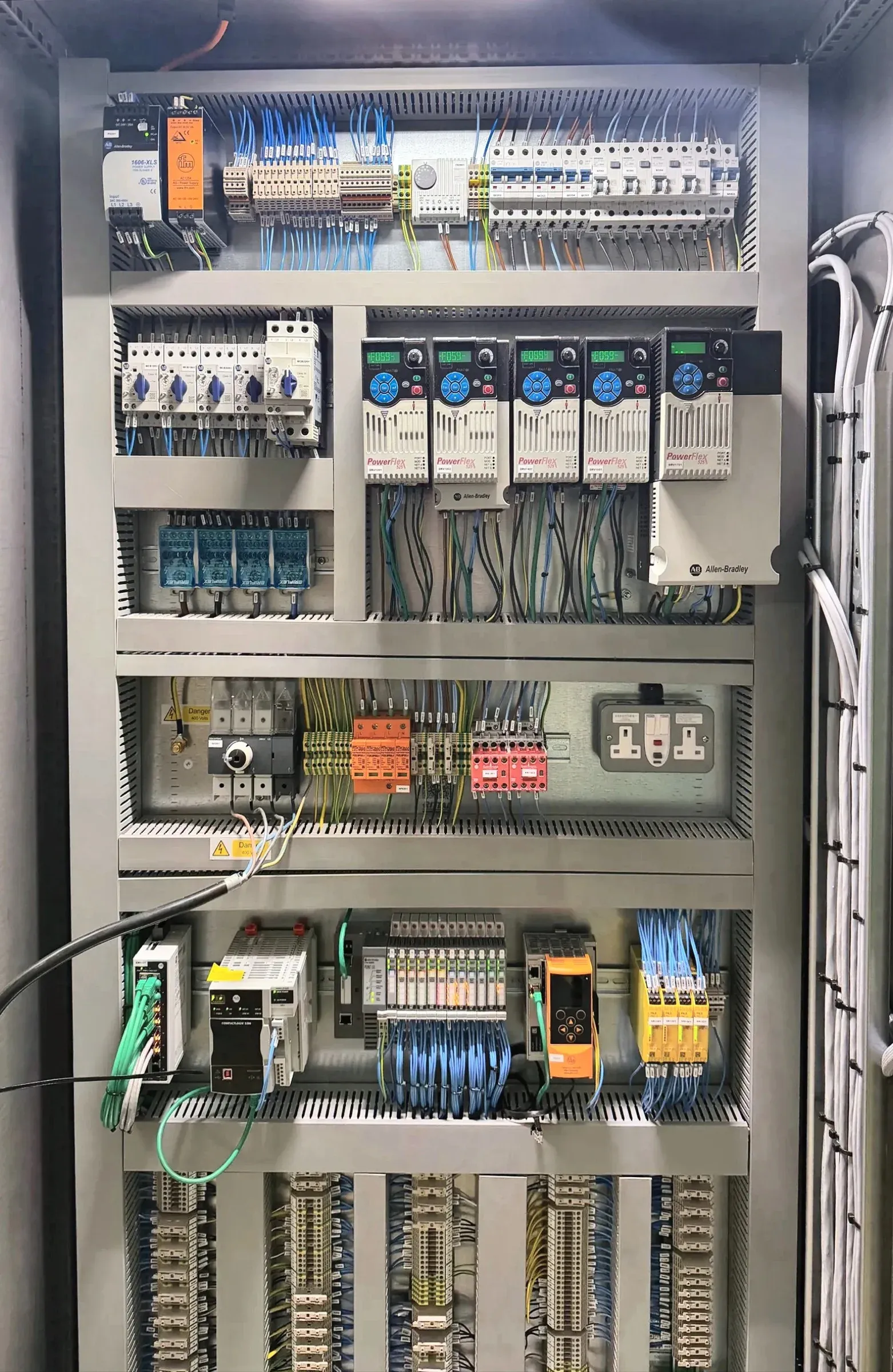
Unlike panel builders working from someone else's drawings, our control panel designers combine EPLAN and AutoCAD Electrical design, PLC integration, machine control expertise and control panel manufacturing to deliver reliable, compliant and future-ready automation solutions.
From new control panel builds to upgrades and system improvements, we provide complete engineering support from concept and design through to installation and commissioning.
What Is an Industrial Control Panel Manufacturer?
An industrial control panel manufacturer designs, builds and tests electrical control panels, also called control cabinets or control boards, that manage automated machinery, production equipment and industrial processes. Our guide to choosing a control panel manufacturer sets out what to ask one.
A professionally manufactured control panel brings together electrical components, PLC hardware, safety systems, drives, wiring and operator interfaces into a reliable control solution.
At Stratos Control Systems, our approach goes beyond panel assembly. We consider the full automation lifecycle, including maintainability, documentation, safety, future upgrades and long-term support.
Our Control Panel Design & Manufacturing Process
- Understanding Your RequirementsWe review your process, equipment, operational challenges and future automation needs before designing your control system.
- Electrical Design & DocumentationOur engineers create detailed electrical designs using EPLAN or AutoCAD Electrical, ensuring every control panel is clearly documented and easy to maintain.
- Control Panel Build & ManufactureOur control panel fabricators build robust industrial panels using high-quality components and recognised engineering standards.
- PLC, SCADA & Machine IntegrationUnlike panel-only manufacturers, we can integrate PLC programming, HMI systems and machine control functionality.
- Testing & CommissioningEvery control panel is checked and tested before installation to support reliability and minimise downtime.
Standards We Build To
Which standards apply depends on the application, the equipment and its intended use.
- BS EN 61439: the principal standard for low-voltage switchgear and controlgear assemblies. It covers temperature rise, short-circuit withstand capability, dielectric properties, internal construction, protection against electric shock and degree of protection.
- BS EN 60204-1, electrical equipment of machinery
- emergency stop circuits, isolation and disconnecting devices, protective bonding, electrical protection, control circuit design, wiring methods, cable identification, documentation requirements
- Ingress protection
- IP54 as standard, IP65 or IP66 where washdown applies
- Verification
- design verification confirms the design meets the required performance criteria. Routine verification checks each completed panel before it leaves the works.
Control Panel Design & Engineering (AutoCAD & EPLAN)
Stratos designs industrial control panels using AutoCAD and EPLAN, ensuring accurate, standards-compliant electrical schematics.
Our design process focuses on:
- Logical layout and cable management
- Clear labelling and identification
- Compliance with relevant standards
- Ease of maintenance and future expansion
- Electrical schematics, panel layout drawings and terminal plans
- I/O schedules and PLC address allocation
- device description, signal type, module and channel, terminal reference, cable reference, engineering units, signal range, alarm and interlock function
- Cable schedules and cable sizing
- design current, current-carrying capacity, protective-device rating, installation method, grouping, ambient temperature, motor starting current
- Voltage-drop assessment
- motors, solenoid valves, contactors, remote I/O, sensors and DC-powered equipment on long field runs, resolved by adjusting cable size, power supplies or distribution at design stage
- Thermal calculations
- enclosure heat load, ambient temperature, component density, ventilation, cooling
- Cooling selection where natural dissipation is insufficient
- ventilation grilles, filter fans, extractor fans, air-to-air heat exchangers or enclosure air-conditioning, chosen against the required IP rating
- Bills of materials and device lists, cross-referenced to the schematics
- Design review before manufacture
- schematics, layouts, I/O schedules, terminal plans, cable schedules, component lists, enclosure requirements
Control Panel Manufacturing and Build
As experienced control panel manufacturers, we deliver precision-built panels for industrial applications.
Our manufacturing capability includes:
- Panel assembly and wiring
- Clearly labelled components and terminals
- Structured layouts for easy fault finding
- High-quality enclosures for industrial environments
- Enclosure preparation
- mounting plates, DIN rail, cable trunking, gland plates, earth studs, ventilation and cooling equipment
- Power and control segregation
- mains and extra-low-voltage circuits, motor wiring and analogue signals, variable-speed drives and PLC equipment, communication cables and power conductors, safety and standard control circuits
- Termination practice
- correct conductor sizing, ferrules and lugs, controlled tightening, bend radius, screen and earth termination
- Identification
- wire numbers, terminal numbers and component tags, all cross-referenced to the drawings, I/O schedule and PLC program
- Approved bill of materials
- components checked for manufacturer, part number, electrical rating and certification before installation
- Drawing-to-panel verification
- component references, wire numbers, terminal numbers, PLC addresses, fuse and breaker ratings, cable sizes
Testing, FAT & Commissioning
Panels are tested in stages before they leave the works, and again on site where we install them.
- Dead testing before the panel is energised
- continuity, earth continuity, insulation resistance, polarity verification, circuit verification, short-circuit checks and protective-device checks
- Live testing under controlled conditions
- incoming voltage verification, control voltage checks, power supply output checks, phase checks, PLC power-up, drive power-up, relay and contactor operation
- I/O testing against the I/O schedule
- digital input simulation, digital output operation, analogue input and output checks, PLC address verification, interlock testing, alarm testing and fail-state checks
- Functional testing
- control sequences, start and stop functions, interlocks, safety-related functions, manual and automatic modes, fault responses and HMI operation
- Factory Acceptance Testing (FAT)
- documentation review, visual inspection, electrical test results, PLC and HMI demonstration, I/O simulation, safety-function checks and any customer-specific test requirements
- Site Acceptance Testing (SAT), where we install
- field wiring verification, device communication, PLC and HMI functionality, safety system checks and functional sequence testing in the live environment
- Commissioning and handover
- power-up checks, field device verification, alarm verification, validation against the agreed specification, sign-off and operator training
Documentation Issued With the Panel
The documentation package is agreed at the start of the project and reflects the panel as built.
- Approved electrical schematics and panel layout drawings
- I/O schedules and terminal plans
- Component schedules and bills of materials
- Cable schedules
- identification, type, origin and destination, core allocation, termination details and cable sizes
- Test records and inspection records
- Factory Acceptance Test documents
- Approved change records
- As-built drawings
- installation changes, revised wiring, updated component locations, final terminal arrangements
Types of Control Panels We Manufacture
We design and build a wide range of industrial control panels, including:
- PLC Control Panels
- Automation & Process Control Panels
- SCADA / HMI Panels
- Control Panel Retrofits & Upgrades
- Bespoke Industrial Control Systems
- Variable Speed Drive Panels, also called variable frequency drive (VFD) panels
- Hygienic Stainless Steel Control Panels to IP66 for washdown areas
- Remote I/O Panels
- Safety-Related Control Systems
- OEM Machine Control Panels
- Control Boxes
Control Panel Platforms & Integration
Our control panels are commonly integrated with leading automation platforms, including:
- Siemens
- Allen-Bradley
- Mitsubishi
- Schneider Electric (Modicon)
- Omron
- Beckhoff
- ABB
Control Panel Upgrades & Refurbishment
We also specialise in upgrading existing control systems to improve performance and extend lifespan.
This includes:
- Legacy panel replacements
- PLC upgrades
- Rewiring and re-documentation
- Safety improvements
- Obsolete components with no distributor stock
- Deteriorated wiring, or a panel repeatedly modified without records
- Insufficient enclosure space for additional equipment
- Incomplete or missing documentation
Ideal for reducing downtime without full system replacement.
From Design to Build Delivery
Stratos Control Systems deliver control panel projects as a complete process, from structured electrical design through to final build and testing.
By managing both design and build, we ensure consistency between schematics, layouts, and the finished panel, reducing errors and improving long-term reliability.
Our approach includes:
- Structured electrical design using EPLAN and industry-standard practices
- Direct transition from design into panel build, avoiding interpretation errors
- Consistent wiring standards and clear, durable labelling
- Logical component layout for easier maintenance and fault finding
- Full panel assembly, inspection, and pre-deployment testing
- Compliance with relevant electrical and industrial standards
- Integration readiness for PLC, SCADA, and existing plant systems
- Consideration for future upgrades and system expansion
Control Panel Manufacturer vs Panel Builder
- Panel Builder
- Builds from supplied drawings; limited involvement after delivery; focused mainly on assembly.
- Automation Control Panel Manufacturer
- Designs the complete control solution; considers PLC and SCADA integration; provides documentation; supports commissioning; plans for lifecycle reliability.
Industries We Support
Our control panels are used across a wide range of industrial sectors, including:
- Manufacturing
- Food & Beverage
- Pharmaceuticals
- Packaging
- Material Handling
- Heavy Engineering
More Than a Control Panel Builder
Many companies can build a control panel. The difference is understanding how that panel performs once it becomes part of a live industrial automation system.
Stratos Control Systems combines:
- Control panel design and manufacture
- PLC programming expertise
- SCADA and HMI integration
- Machine control experience
- Legacy system upgrades
- Electrical documentation
- Ongoing automation support
This ensures your control panel is designed not only to operate today but to support your facility in the future.
Why Choose Stratos Control Systems
We don't just build panels, we build systems engineers can actually work with.
- Designed to BS EN 61439 and BS EN 60204-1
- Clear, structured panel layouts
- Control panel standardisation
- PLC, HMI and panel designs kept consistent across machines and sites
- Full documentation provided
- Built for reliability and maintainability
- UK-based engineering support
- Every panel tested before dispatch, with test records and as-built drawings available on request
Questions
What is included in a control panel design and build service?
A control panel design and build service includes electrical design, panel layout, component selection, manufacture, testing, documentation, and support through commissioning and handover.
What does a control panel manufacturer do?
Designs, builds and tests the panel, and verifies it before it leaves the works. For a switchgear or controlgear assembly that means BS EN 61439: design verification once for the design, routine verification on every panel built. For the electrical equipment of a machine, BS EN 60204-1.
How much does control panel design and build cost?
It depends on the enclosure, the component count, the I/O and the testing regime, so settle the specification before the quotation rather than discovering it afterwards.
What standards do industrial control panels need to meet?
Industrial control panels are commonly designed to BS EN 61439 for low-voltage switchgear and controlgear assemblies, and BS EN 60204-1 for the electrical equipment of machinery. Which standards apply depends on the application, the equipment and its intended use.
How long does it take to build a control panel?
Typically four to eight weeks from order to factory acceptance test. Long-lead components and the FAT date are what move it most.
What is the difference between FAT and SAT?
Factory Acceptance Testing is completed in the works before delivery and covers documentation review, visual inspection, electrical test results, I/O simulation and a PLC and HMI demonstration. Site Acceptance Testing is completed after installation and verifies field wiring, device communication, PLC and HMI functionality, safety systems and functional sequences in the live operating environment.
What is the difference between design verification and routine verification?
Design verification confirms the panel design meets the required performance criteria, covering areas such as temperature rise, short-circuit withstand capability, dielectric properties and degree of protection. Routine verification checks that each completed panel has been manufactured correctly before it leaves the works.